
“We are so proud to have had Lodge 49 on our air…This wonderful show gave audiences fresh and unforgettable characters in a world that did not exist anywhere else on television.”
– AMC execs’ statement announcing the cancellation of Lodge 49 two weeks after its Season 2 finale on 10/19/19
1. Is this too little, too late?
The English poet Sir Geoffrey Hill (1932–2016) gave 15 lectures as Professor of Poetry at Oxford from 2010–2015. In one of these memorable deliveries of dry wit and drenched knowledge, Hill remarked upon a theme he returned to many times in his critical work – namely, that we live in a cultural age in which “everything that is of value is thrown away with everything that is trash.” This ‘everything’ in his statement was primarily focused on poetic and literary output, but it might not be a stretch to extend this assessment to film, music, and television as forms of art that are also prey to the wasting disease of our contemporary situation. Most of us are unfortunately wired to assess the value of something new based on the raucous shrill of our social media feeds. At the time of the beginning of this writing, no one could get enough of HBO’s House of the Dragon, and just the other week, the Succession series finale, and next it will be…White House Plumbers? Maybe not, but something else will come along, dressed in gold, and promptly melted down after the gilding tarnishes.
It’s engineered that way. Consider: one year’s hit, last year’s award winners, and this summer’s blockbuster — how many of them remain long in your individual, let alone cultural, memory? One passes and another takes its place. As soon as most of them are here, they’re gone. Critics and advertisers (is there a difference today?) assure us that we live at the apex of television, the height of musical ingenuity, the zenith of cinematic excellence. Entertainment, like many technologically-enhanced activities, rides a wave of human progress. Never mind if you can’t recall or remember that show or film you’re trying to remember to your friends — another will come along to be consumed, buzzed about, and then tossed away to make space for the next, and, apparently, better media than before. Some of us, like Hill, suspect otherwise…
I highly doubt that if he were alive today, Sir Geoffrey Hill would think much of my utilizing his insightful and biting criticism to apply to the passing away of Jim Gavin and Peter Ocko’s Lodge 49 by AMC, canceled in its second season and soon to disappear from Hulu with no DVD or Blu-Ray releases for current (or future) fans. This post is an attempt to sing a song of praise in Hill’s poetic vein — and I do think the seasons we have of Lodge 49 are deserving of it for its narrative, themes, and characters, who yes, have not existed anywhere else on television, as the rich fools at AMC mention above. But more profound than the futile call for the renewal of a dropped show is our need to recognize that we have an obligation to be selective of what we give our attention to, and furthermore, to ask ourselves: can we give it meaningfully? If we are routinely duped by producers of entertainment landfills, by oligarchs of late-stage capitalism, or by the rule of austerity of attention which perpetuates a seen-and-done level of engagement, how do we escape a steady slide into consumer and existential cynicism?
We need to fight for art that sees more in us and asks more of us than plugging in and dropping out. Lodge 49, at its root, honors this struggle.
2. Getting Lost on the critical path
Why the cancellation? Well, steering clear of the Nielsen rating discussion, which is completely fractured due to our ever-mutating viewing habits, and ought to be totally reworked and re-standardized, most critics of the show who thought and wrote about it could be grouped under the “failure of optics” label — Lodge 49 was categorically described (I’m paraphrasing the league of writers at entertainment writing mills like Ready Steady Cut, Den of Geek, and RogerEbert.com) as “a show which cannot be described, but a good show: check it out!” But that’s not a hook. Neither is “quirky” or “fresh” – shit can be fresh. But also, we don’t want good – we want great, excellent, sublime, buzzword, etc.!
When the cancellation statement’s ink dried it really read with an outdated “low viewership” judgment and joined the ranks of Arrested Development and other critical darlings that have succumbed in the past two decades to critical dissonance. How then can we account for this lack of appreciation/engagement and the cancellation of Lodge 49? Was it the temporal fault of our changing climate of television and its (dis)appearance in the wake of AMC’s Breaking Bad and the ascendancy of Better Call Saul? Was it a fault with the show’s writing, with its unabashed focus on material debt, spiritual grief, and the death of the middle class? Or was it a fault of the critics and their own lack of objectivity and shirking of dutiful responsibility to a suckered public?
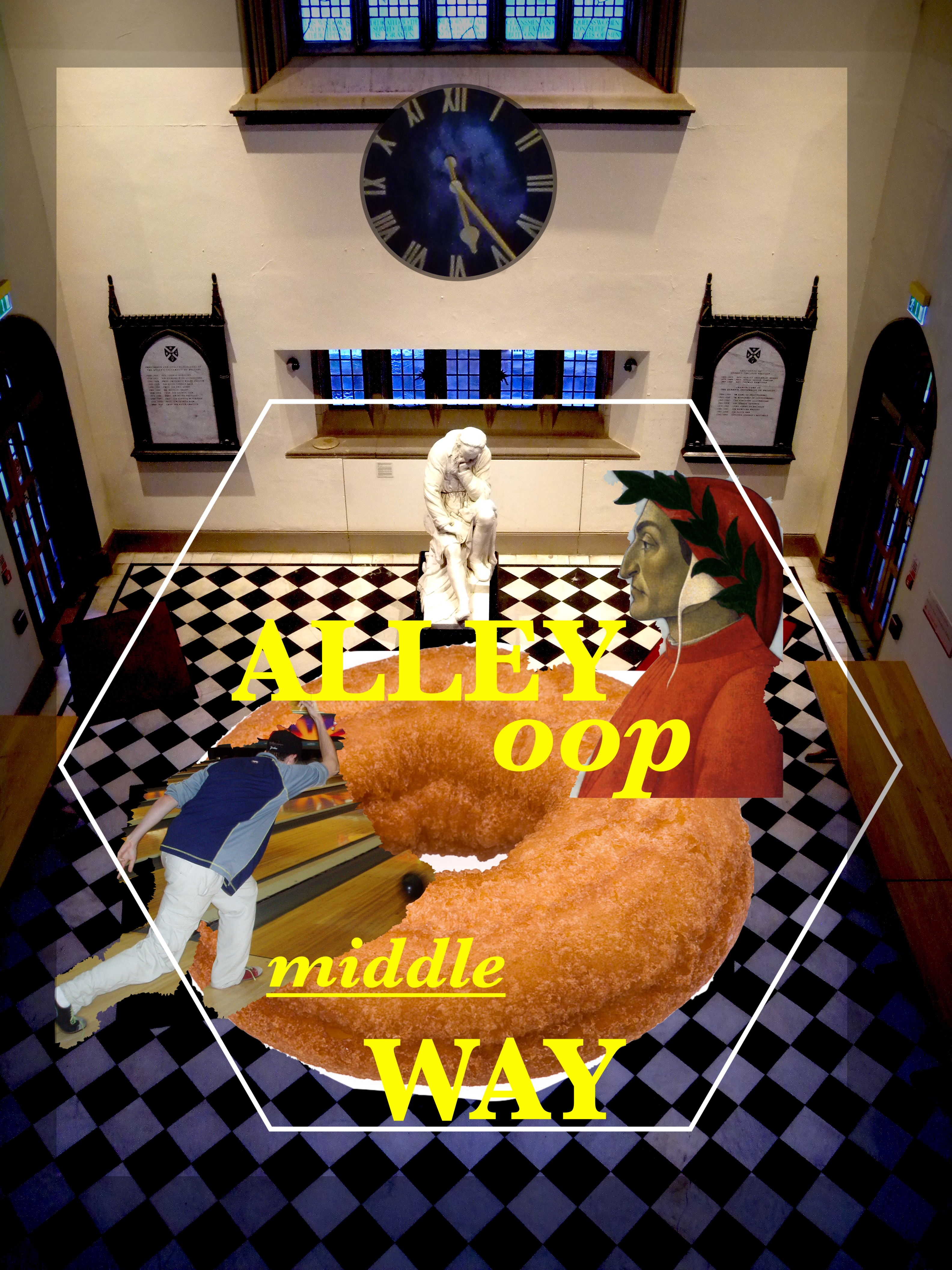
This author chooses to surmise that the answer partakes in all of the above reasons and that the tangle of quanta is as hole-ly as it is wholly – much like a donut.
3. At the donut shop – circular is curiouser
Stepping into the uneven soles of the critics, I claim that what made, what makes, Lodge 49‘s 20 episodes of high, shining quality, glittering out from the dung heap, is the key importance of the simultaneity of person/place in its structure. The title of the show is, after all, based on the quasi-Masonic inspired space where main character Sean “Dud” Dudley enters after his car breaks down just outside of its front door, the very door that the viewer ‘enters’ in the opening credits at the beginning of each episode. Furthermore, he is mistaken for someone else, another young man whom Luminous Knight Ernie Fontaine is waiting for “to do the carpets.” Throughout the show, people mistake each other for others and mistake themselves for who they wish themselves to be – or, who they are aiming to become. Carpets do indeed require cleaning, but Dud is there to clean spiritual carpets – in Lodge 49, these are the ones that have been lain down in its halls by its forbearers, a straight way lost, and in this manner can be understood as a microcosm of the inner life – the place where dreams were made, betrayed, and require some kind of renewal or redemption.
And so Dud, an ex-surfer who had just lost his father in the last year (remains not found, corporeal/spiritual existence unconfirmed) enters, invited to become a Squire in a space/place that he finds immediately familiar and yet completely new. Along with him, we find the common people who are trying to transcend their ordinary lives: Ernie, a salesman living under gambling debts and deadened dreams; Connie, who has rekindled high school love with Ernie but is losing her job with the extinction of journalism; Scott, Connie’s husband, a glorified security guard (harbor patrolman) whose purpose in life is to keep Connie happy while she suffers from an unknown disease; Blaise, a pot salesman/former student of every-which-Way who seeks the real substance among the distillation of his failures; as well as a small host of peripheral characters who make up the gradually thinning dross of middle-class America.
There are teachers, waitresses, and former industrial workers – and what they all share in common (if not the Lodge) is that the future looks bleak under late capitalism’s sky. Many characters work multiple jobs, are baited into pyramid schemes, try their luck at cards or betting horses, or attempt to climb the corporate ladder. What works well in the show with this circular cast of characters is that even though each of them spins their chances on Fortune’s wheel and sees where it carries them off, they suspect that there is something else – something missing. Call it the absence of God, a lack of meaning or purpose in the Universe, or a disgusting yet orderly fly in the ointment of chaos. For some, its name is alchemy. For others, the “True Lodge.” And for others still – Antarctica?
4.
A donut is delicious because of its vacancy in the middle – I’m sorry, but we’re tabling jelly-filled – or, okay, if you prefer, they represent organized religion or other systems that seek to resolve the reality of the something/nothing dichotomy of being. Don’t worry, I’ll stay away from Heidegger here – but as Dante put it (there we go!) in the middle of life, we are in a dark wood and have lost our way. Most characters on Lodge 49 are appreciatively middle-aged, perhaps another reason for its poor reception, and are having to face the reality of being over the hill or soon over it without much to really show for it, materially or spiritually. What Jim Gavin and Peter Ocko put forward is an artful – and simultaneously heartbreaking and hilarious – approach to this dilemma of fulfillment/enlightenment: you can’t get there alone.
I believe that this is the real culprit of Lodge 49‘s unpopularity and the reason you should be bingeing it this week. The show subtly reveals the pressure points of the imploding myth of progress, as well as the pure-bred American cowboy fantasy of rugged individualism. It’s a kind of artistic response (the way that T.S. Eliot responds to Dante, and Hill responds to Eliot) to Robert Putnam’s Bowling Alone. A recent article published in Jacobin by Anton Jager details the 20 years since the book’s publication, but the long and short of it is that the isolation wrought by wealth inequality, outsourced workforces, mass suburbanization, and diabolic political gaming has ensured the tearing down of the mythical flagship “American Dream.” The loss of the Dream is saddening, but the Impossible Dream of having and holding real partnerships, based on a True source of love, understanding, and meaningful connection, is more pressing and necessary.
Lodge 49 is simultaneously grieving the loss and dancing upon the postwar grave. Refreshingly, and with great humor and pathos, this dance of death is also for the reactionary counterculture of the ’60s. This is part of the real genius of Gavin and Ocko’s show. That mirage of seduction yet burning at the extreme West of our nation – in the glow of wildfires no less – is remade. Characters begin to recognize, and we along with them, that the real question and mystery of the cosmos isn’t nestled in the individual human heart, by material or spiritual alone, but in the negative space we hold and create amongst one another. There’s no hierarchy, no greater power, no divinity, but for what we renew through our loss. In a time of silent and soul-numbing grief, this show is able to plant a quiet seed of joy and hope that other possibilities of career, community, and family, may yet appear through the smoky veil of the present.
5. In summation…
Watch Lodge 49 before it leaves Hulu on the summer solstice. The timing couldn’t be more ironic. Thanks for reading – GDB

 G.D. Burns, Poet-Educator