Greco-Mormon: Background and Introduction

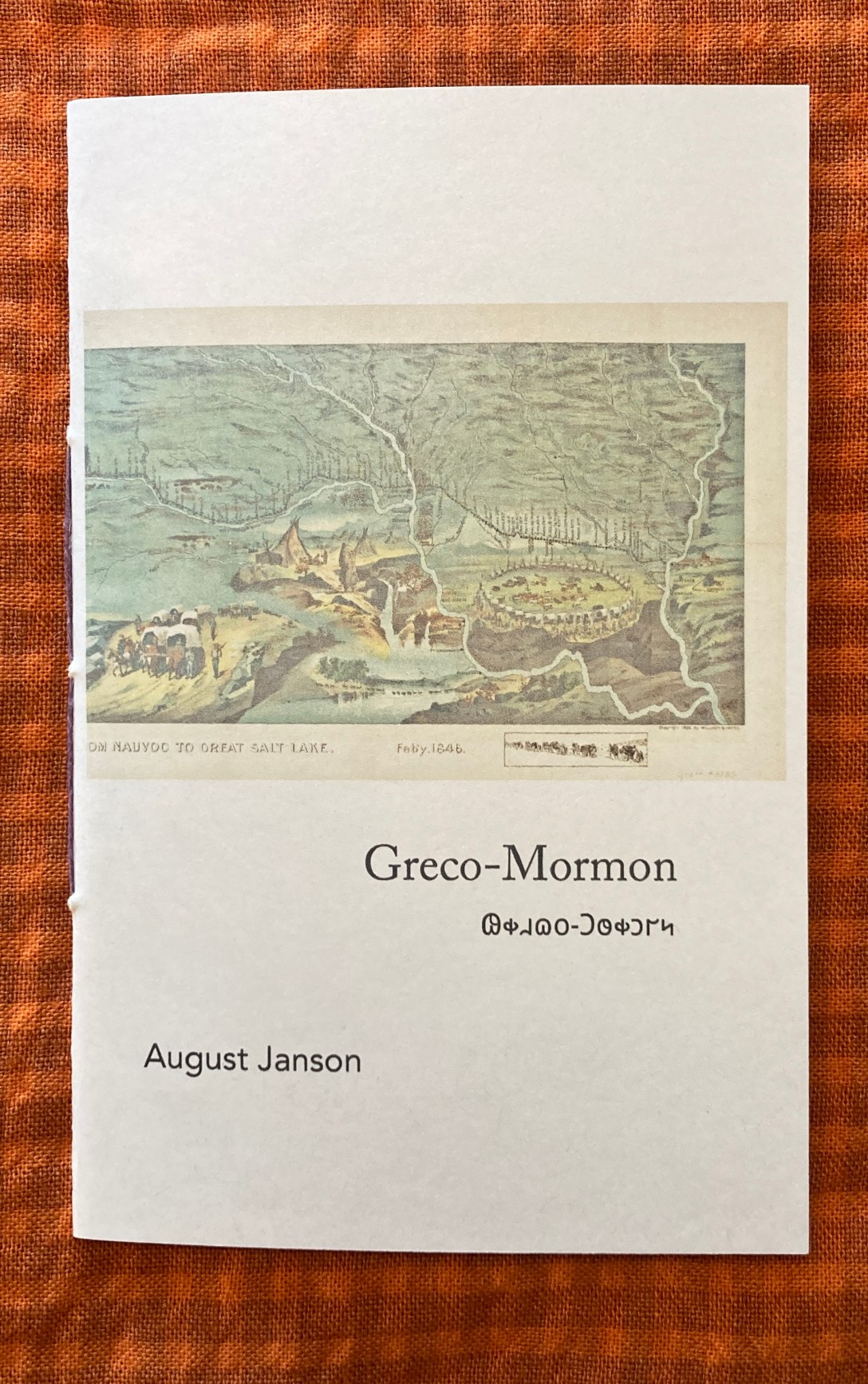
I’m genuinely elated to announce this Monday, March 25th, 2024 the release of Greco-Mormon, a new chapbook under my fresh pen name August Janson. In its 43 pages are 12 poems written and edited over eight years, divided into two parts, with two longer sequences of seven and 10 poems respectively. The edition’s run will be 250, my largest self-produced printing to date. Orders will be fulfilled on-demand with the first 50 copies in a hand-stitched binding.

Greco-Mormon can be published in my Ko-fi store here for $10 (postage included)

My intention below is to give some personal and historical context to Greco-Mormon. Like a book’s version of special features, this isn’t necessary for an appreciation of the poems individually or the collection as a whole, but rather to serve a scant purpose for the critically curious, however long the coherence of the Internet lasts and while there are potential readers of American poetry with an eye on the present and an eye on the past.

Why the pen name August Janson: A brief genealogy

Although I no longer practice the faith I grew up in, when dug up and exposed to the stark sunlight of the Great Basin, my religious roots reveal them to be fifth generation Mormon. I was in the church from birth to 18 – technically from 8, the age of baptism and confirmation in the LDS church. I’ve never rescinded my membership and have walked other paths of practice since 18, but although I’ve lived longer not attending the church of my ancestors than attending, the resonance of its teachings, hymns, beliefs, customs, and the whole octave of its paradoxical culture still rings in my ears. To turn down the volume, I needed to distance myself by giving the poetic voice of these poems a new name – though, not entirely new.

I was born with the last name Janson. It was given to me by my biological father Phillip John Janson, who recently died in August 2023, and was preceded in death by my adoptive father Bob (who gave me his adopted surname, Burns, in 1990), and my stepfather Charlie, all to whom I dedicate the chapbook. The Jansons I descend from on Phillip’s side are Jansons of Sweden’s Stockholm and Uppsala Counties, rather than Jansons from Britain, Ireland, France, or Germany (see this 23andMe page for the commonality of the surname). Phillip’s father, my grandfather Alonzo (“Lonnie”) Delmar Janson was the grandson of Frans Gustaf Janson, whose journey to the land of Deseret began with the informal visits and home teachings by Mormon missionaries, in fact, the first elders sent abroad to the non-English speaking countries of Scandinavia.


The front cover of the chapbook with explanatory notes
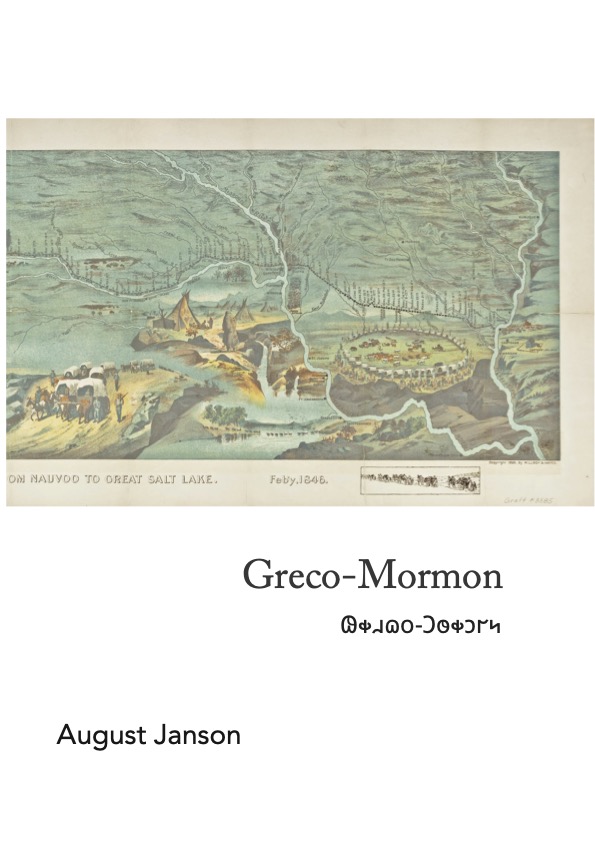
The cover of Greco-Mormon, with a digital clipping of the route taken by Mormon pioneers from Nauvoo, Illinois to the Salt Lake Valley in Utah Territory in the winter of 1846, later known as the Mormon Trail.

The script below the title is the same in the phonetic alphabet Deseret (a term meaning “honeybee”) that was developed in 1854 by George D. Watt, the first English convert to the LDS church, at the behest of the second prophet and president of the church, Brigham Young.

The purpose of developing the alphabet was both theocratic and functional. Before statehood, Young was the leader of both the church and the State of Deseret, and the script served as a means of helping converts quickly learn English phonemes from non-English speaking countries – initially, from my ancestors in Scandinavia (Source: http://deseretalphabet.org/)


In the mid-to-late nineteenth century, Sweden had only just ceased enforcing religious laws of compulsory (Lutheran) church attendance, laws against religious conversion, and laws barring emigration. The first part of my pen name, August, is in honor of Maria Augusta Carlsson who married great-great-grandfather Frans. She had also converted to the early LDS church in Sweden and left her family to emigrate to the US to help “build the kingdom.” This is quite a historical irony, as Swedish converts who crossed the Atlantic and followed the Mormon Trail to the American West were leaving a native country that was gradually democratizing and pulling apart church and state – only to arrive in the theocratic bastion of Utah Territory where both were the same.

If Frans Gustaf and Maria Augusta hadn’t chosen to take their individual leaps of faith across an ocean, they wouldn’t have met one another across their adjacent hotel rooms in New York City in late September 1875, beginning a patriarchal sequence of marriages and birthings that produced me 110 years later. My Mormon and American story begins earliest with them, and so August Janson is both the subjective double and poetic object of Greco-Mormon.


The frontispiece to Greco-Mormon: Detail of carved sunstone relief sculpture from the original Nauvoo Temple (1841-1846) before its abandonment due to religious intolerance and destruction by arsonists (Source: https://history.churchofjesuschrist.org/content/museum/museum-treasures-nauvoo-temple-in-ruins-lithograph?lang=eng).


Greco-Mormon can be published in my Ko-fi store here for $10 (postage included)

The title of the chapbook: Mythopoesis and history

Yes, it’s a cheap and punny chapbook title that reminds you of school – so the following brief lesson by me, a certified teacher, has the historical and anecdotal information you’ll need to understand for the Greco-Mormon quiz you can unlock with the enclosed code you’ll receive after purchase of the chapbook (sarcasm detected):

The Greco-Roman period was short, close to the same amount of time between my great-great-grandparents and me (116 years – approximately how long it took the LDS church to get to its first million members). The Achaean League, the last alliance of Greek city-states, was dissolved by the Roman Republic after the Battle of Corinth in 146 BCE, marking the official end of Grecian sovereignty, as well as the tapering off of Hellenistic art and culture. The Greco-Roman period is usually demarcated at 30 BCE with the absorption of Ptolemaic Egypt and the establishment of the Roman Empire by Octavian. Technically speaking, the Greek peoples never again ruled over themselves until the Greek War for Independence in 1821, the year when Joseph Smith first claimed his theophanic vision occurred (there are multiple versions, suggesting a sculpted narrative by Smith).

The Romans absorbed the lands and peoples of the Greeks but had also for the previous centuries been grafting the wisdom of Greek philosophers and their styles and techniques in the plastic and performative arts. This further differentiated them from their native Etruscan ancestors in the Apennine Peninsula, and if we subscribe to Virgil’s Aeneid as being more than mythopoeic nation-building, taking some truth in the origin of Rome with an Aeneas-like figure with errant Trojans [read: Anatolians] ending up along the Tiber, another instance of “Latin” cultural diffusion. I would argue that the Aeneid can be read as a precursor myth of Western expansion, with a people fleeing a city of destruction and journeying through the wilderness (of the Mediterranean Sea) to a new home – the same story at the root of the settling of Deseret and by my Mormon ancestors. End of lesson.


The back cover of the chapbook with a key to its constituent parts
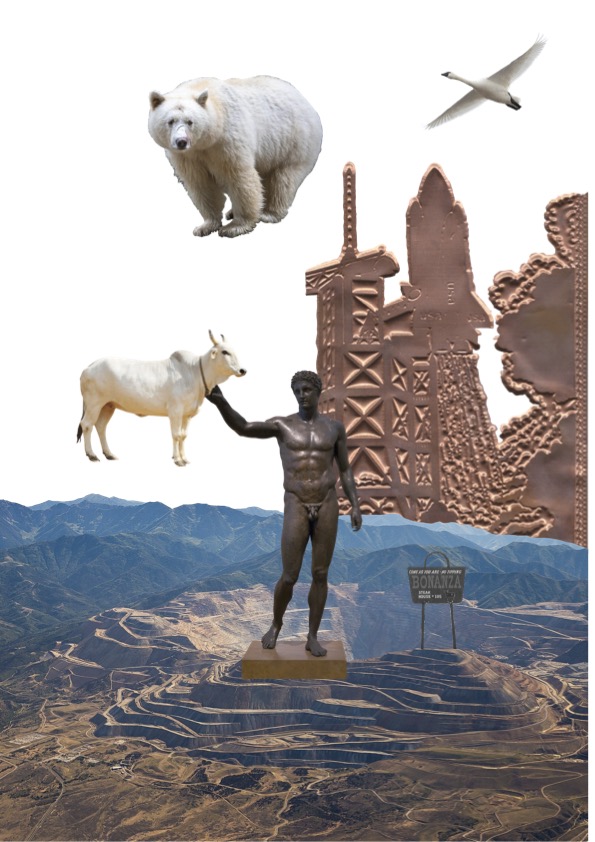
  • Center-right: Scan of a copper postcard of a space shuttle launch, made using copper mined in the Salt Lake Valley at Bingham Canyon (pictured at bottom), the largest man-made excavation on Earth
  • In an arc: Three animals representing prominent Northern constellations: Taurus, Ursa Major, and Cygnus – one tamed, one wild, one free
  • Center: The Antikythera Ephebe statue, found in a Greco-Roman shipwreck in 1900, most likely sculpted by Euphranor of Corinth in the 4th century BC, which I’ve made to look like he’s “taming the ox” of the heavens, though it’s believed he actually held a sphere – perhaps a golden apple
  • Right: Clipping of a road sign in Texas for the Bonanza steakhouse, where my adoptive father Bob worked during high school, started by Dan Blocker, a TV actor from the show Bonanza (1959-1973), set during the era of Mormon migration and Western expansion

Extra-credit. A salient point that should affect the reading of my poems hinges around the testimony of members of the LDS church in the truth of The Book of Mormon as another testament of Jesus Christ, but more specifically, a factual historical record of the Ancient Americas. That history begins in the Middle East with a lost tribe of Israel led by the patriarch Lehi out of Jerusalem before it fell to Nebuchadnezzar. They then traversed the Atlantic to the Americas where they established a Judaic/Christ-anticipating (not exactly Messianic) religious civilization, like a Christian Aeneas or a New World Noah.

Regardless of one’s testimony, the archaeological record does not provide any abundance of hard evidence of such an origin story of the American people. The genetics of indigenous peoples who migrated to America across Beringia reveal Northern Asiatic origins between 25-10,000 BCE, not Middle-Eastern Semitic from the 6th century BCE. Technologically, the first peoples advanced enough of whom we actually have evidence of traversing the Atlantic to America are, in fact, 11th-century Scandinavians. Mediterranean vessels for many, many centuries before and after Lehi’s time had much too shallow of a freeboard (the distance from the waterline to the upper deck level) for transoceanic travel. Although according to The Book of Mormon, as with Noah in Genesis, Lehi was shown a way by God. For the true believer, the matter is one of faith, not fact.


Illustration of Ubbo’s Hall (the Norse temple to Odin/Freyr in Uppsala, Sweden) as described by Adam of Bremen, from Olaus Magnus’s Historia de Gentibus Septentrionalibus, 1555.
In 1087, around thirty years after the latest carbon dating at the L’Anse aux Meadows site, the temple was burned down by Sweden’s first Christian king, Inge the Elder.

Unfortunately, the fact of the discovery of the Scandinavian settlement at L’Anse aux Meadows in Newfoundland has been hijacked as grounds for a land claim to all of North America by white nationalists of this continent, and as a further means of justifying arguments and actions in the past, present, and future for the harm and eradication of indigenous peoples. This contemporary and ancient darkness is addressed in one of my final poems, “The Exegesis of Jeremy Christian,” centering around a double homicide motivated by racial hatred in my adopted hometown of Portland, Oregon in 2017, a city that has been in the 20th century and now this one a sometimes clandestine, sometimes out loud, northwestern headquarters of the Invisible Empire.

So, at the deepest levels of my ancestry, there are mythic quakes from the stony pantheon of pre-Christian Norse gods; alternative Judaeo-Christian histories; and nearer the surface, craven eugenicist designs of erasure (through massacre or conversion) of native peoples by the act of “settling” the American West. The last of course isn’t particular to my line, it’s just the unabashed nation-building story of populating an “empty” America. Poetry that will surely outlast my own and might even, rightfully so, render it inert, is being produced by Joy Harjo, Sherwin Bitsui, and many others, against a lineage of oppression and alongside the fractured inheritances of their ancestors. How does a non-native poet come to terms with their past and the shadow it casts over the very reason for their being here at all?
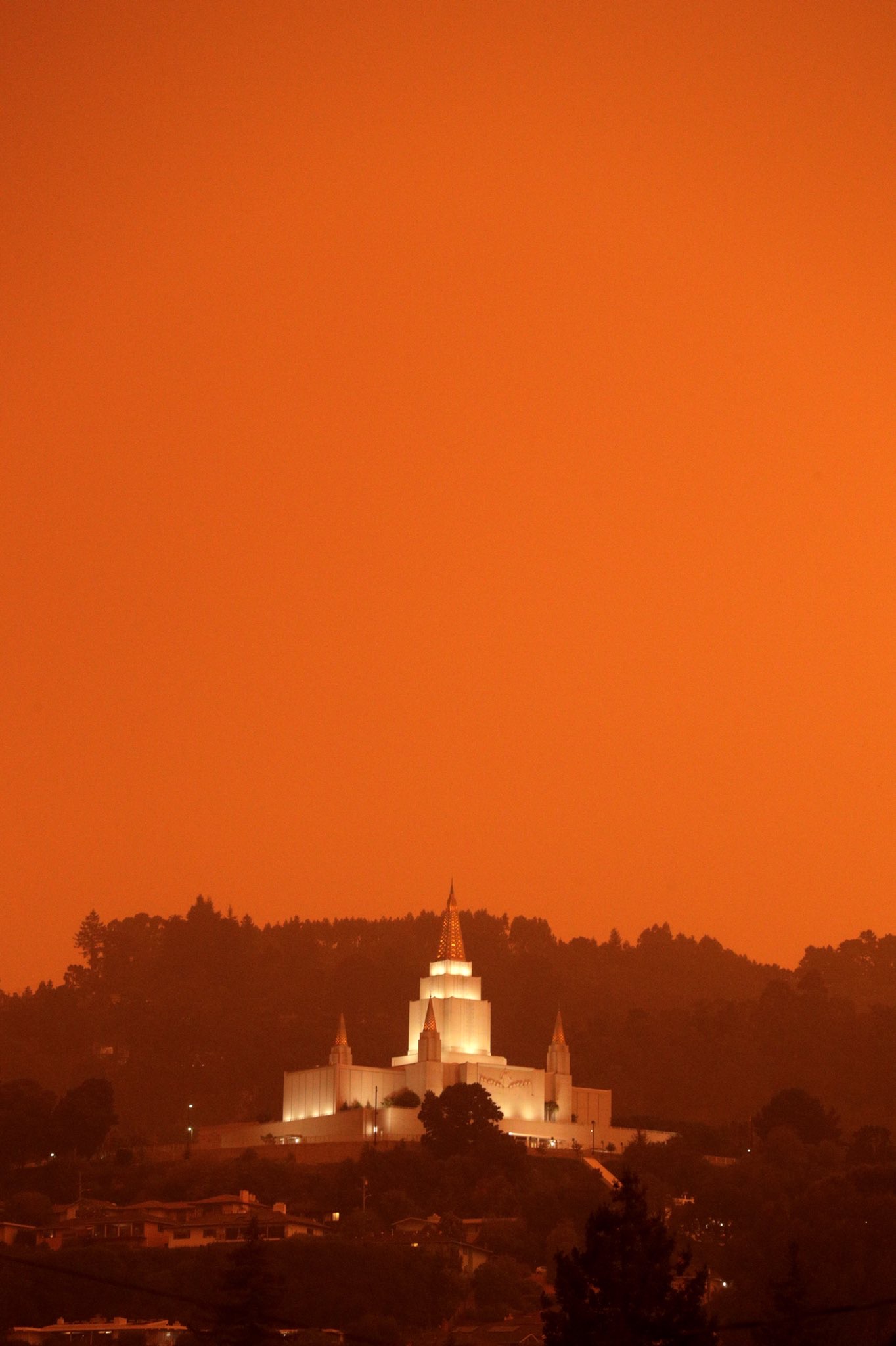

Photo taken of the Oakland Temple (a place my friend Cailie thought was Disneyland as a child growing up in the Bay Area) under a red sky during the SCD Complex Fire between August and September 2020


Final considerations: Mountains and seas

My aim was to have Greco-Mormon stand like a website banner over the amalgamation of my origins: temporal/secular, eternal/religious, matriarchal/patriarchal, life in church/away in school & society. As I get older, geometry and geology, quantum physics, and political philosophy inform a lot more of my work in poetry, and one could use the analogies of layers of sediment or quantum states for the chapbook. The existence upon which the present is built, whether self or nation, only stands because it can do so in a hierarchy of accretion. In this sense, excavations might be a more apt analogy for my verse.

Among the poems of Greco-Mormon are fluctuations in pitch and timbre depending on their level: grief, dads, religious violence, paradox, climate change, fertility, and faith. Faith is not a fact, but it is a facet of the lives of people who have shaped and influenced me. In the opening lines of Greco-Mormon, in my poem “The Happy Search,” I distill this with

Faith can move mountains

And so can bulldozers.

These two lines are on their surface a statement about the Holocene and the terror of our earth-scalping Anthropocene, the mass effects of the industrial reshaping of the surface of Earth, a scale of activity that turns the parable of Jesus into a grim irony. They aren’t against his teaching or the power of faith, but that there are different levels of truth, of ruin, of miraculous occurrences. “And so can” doesn’t nullify the parable but adumbrates it, lining the former image with an absence made by its opposite – brute force.

Temples in the LDS church are called “Mountains of the Lord” and mountains have long been spiritual symbols of the connection between the earth and the heavens. Without the stonemasons of Northern Europe, the spires of the Salt Lake Temple would never have risen above a transformed desert landscape. However, the real strength of one’s faith ought not to be anchored in anything material but in consciousness itself, the unseen. A mountain was a fitting multi-layered image to begin the chapbook, and it’s the start of a constant interplay between the heights where I was born (Provo, Utah sits at 4,551 ft above sea level) and the sea to which everything eventually flows, like particles of cremation ash.

I still carry around one strong belief: that successful poetry should speak to you from a deeper level, plucking strings that resonate with acoustic forms behind or beneath our purely sensory-based faculties and culturally informed optics. Poetry that works touches a place where memory and reality mingle, where language can be less opaque as quarried stone and more layered and translucent like an agate. This belief is based on my own reading, writing, and teaching of poetry. After 35 years of reading, 25 years of writing, and 5 years of teaching poetry, I’m wrestling with myself toward this aim all the time. We might forget that so many science experiments are failures but poetry is no exception. Often enough in both cases, mistakes count and can even produce a different result than hypothesized or expected.

What previous generations of Americans have believed and expected, and especially what Christian Americans of all denominations were or still are proud of, ought to make current generations blush with shame and curdle with righteous horror. How we address, process, and integrate the terrible truths of our lines of blood or adoption is a question that plagues me as the lingering effects of a pandemic virus. I don’t feel I have a choice to deny such an embodied question that exists with my climate grief, pain from the loss of my faith, and dwelling with the sins of my fathers. Has this or does this question lead me to a barren or fertile ground for bringing up poetry? Well, Greco-Mormon by August Janson is one form of an answer.

Greco-Mormon can be published in my Ko-fi store here for $10 (postage included)
September Announcements

Chapbook

Capping off the multi-month marathon I dubbed “Tuesday’s for the Poetry” as a capstone to the quarter-century of poetry composing that I completed on my YouTube channel (Nights 8-25 available on this playlist, the first seven available as reels on my IG – request to follow!), I am now offering in limited quantity FOR SALE for $5 each (postage included), the remaining 25 copies of my first self-published chapbook, Haiku Composed on an English Tour!

This title was actually featured in one of my first posts on this, my official author website, back in March of 2015. Only 25 of the original 50 were assembled and handbound, so these remaining 25, whose covers and title pages have remained in my possession for over 15 years, are now being printed and staple-bound, waiting for their first readers! If you would like to purchase a copy from me, please Venmo me $5 at Gary-Burns-10 and email me your postal address at poet-educator@garydaleburns.com. Once payment is confirmed, your unique, hand-numbered copy of Haiku Composed on an English Tour will be assembled and mailed!

Substack

As one chapter ends, another begins. My next regular project will be producing weekly newsletters via Substack. I am carrying over the name of the poetry recitation nights, Tuesday’s for the Poetry, and you can subscribe (for free at first – paid subscriptions with added features coming soon!) at https://garydaleburns.substack.com/. The first newsletter is released this coming Tuesday, September 5th. If you are already subscribed to this author website (through email) your subscription has been carried over. I look forward to meeting new readers and writing shorter works of prose on a variety of topics on poetry and more!

– Your poet-educator, G.D. Burns

Tuesday’s For The Poetry!

In recognition of, celebration in, and reflection upon 25 years of writing poetry (once this August arrives), I began two months ago on March 14th to recite the poems of my past on Tuesday evenings, each evening sharing one year of poetry. The first seven nights were on IG Live, my very first time using this service, but because of the limitations of ownership and control available to users through Zuckerberg’s monster Meta, I have moved the Tuesday evening recitations to my YouTube channel, a website that remains a halfway decent “location” for creators and communities on the Internet.

This Tuesday, May 16th, at 8 PM EST, I’ll be reciting the 10th night of poems, these from the year 2008, when I was 22 and 23. Tune in and join a small but growing community of interested persons in witnessing the evolution of a poet, unabashed and unfiltered, the poor compositions and the great, as I openly share the trace of poetic concerns that have developed and made me the poet I am today.

Poem at Sanctuary’s Poetry Corner

https://www.sanctuary-magazine.com/poetry-corner.html

Fellow poet Mare Leonard invited me to share a poem for her newly instituted Poetry Corner of Sanctuary Magazine. I was honored and delighted to contribute to this new space where in Mare’s words, one can “share a taste of poems that will make you think, laugh or wonder.” I share her concern about the readership of poetry and highly recommend catching her reading in the Hudson Valley in the near future.

The poem published is from my unpublished full-length manuscript, Hugh Melody and other poems.

From left to right at a poetry reading on Indigenous People’s Day last year: a Bardian group of poets – Peter Ullian, Mare Leonard, Gary Dale Burns, and Derek Furr

Published in Chronogram

In late 2016 I had a poem, a short haiku, published by Philip X. Levine in the monthly Hudson Valley periodical, “Chronogram.” This year, I have the honor of another of my poems (“Older Male Friends”) published by this same supportive editor in the August 2018 issue of the magazine. The poem, along with Levine’s other selections, can be read here online, and the entirety of the magazine can be perused here on Issuu.

img_2699

This is an unrelated picture of Keanu Reeves, who is my spirit animal.

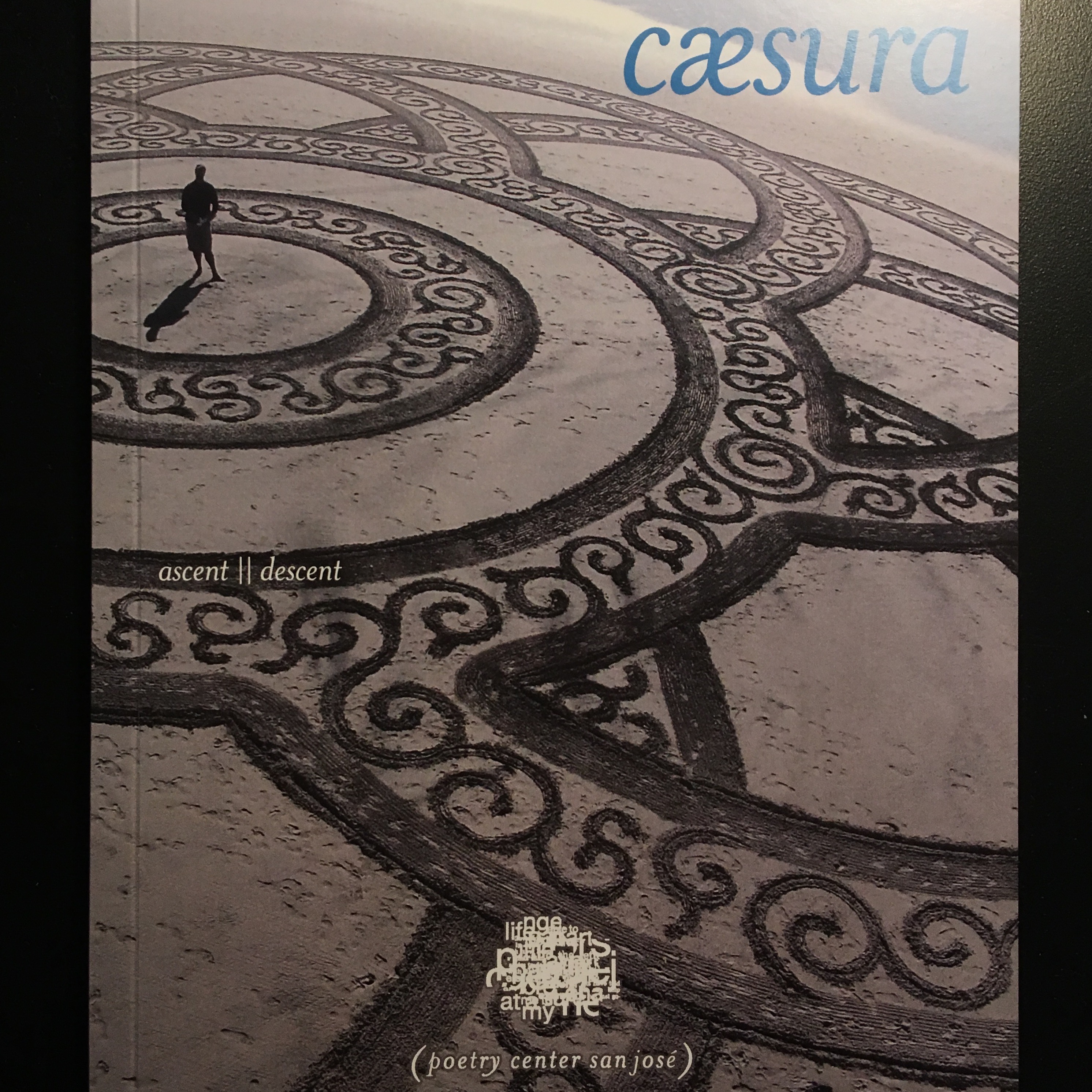
Published in Caesura

IMG_3375

I am very pleased to announce that last month the Journal of the Poetry Center of San Jose published a poem of mine (“Hugh Melody : I”) in the print copy of their annual publication Caesura. The online version can be read here but it is of a different form than the print version, with all-new authors and differing selections. If you would like to order a copy with me, send me a message and I will try and procure you one at a discount.

Instagram and Poetry Month

This past April was National Poetry Month, as it has been every year in the U.S. since 1996. While I do sympathize in some part with the quiet criticisms of the celebration, a somewhat trivial designation for the public’s attention to turn toward poetry (the point being that after you’ve taken brief notice of the fact of its existence you can then continue with your general neglect of poetry), I decided to say Bernstein be damned and take on a reflective self-challenge.

I wrote a poem each day this April and posted it to my Instagram feed (not too far of a scroll away). Being my birth month, I associate the Spring and the re-awakening of the earth in this hemisphere with creative activity. But never have I forced myself to compose one poem, each day, for a month, as if I were manually breaking open seeds and thrusting them through to the surface prematurely. Most took in some light (and likes) amidst all the visual splendor of that medium. After week one I gained a steady pace of alternating between writing and posting, then took time to peruse the other poets at work through the convenience of Instagram’s self-making engine.

What I found was a strange mix. There was certainly cobwebs-upon-cobwebs of cliched and tired metaphors applauded with fan hearts and digital accolades, but there were also some authentic voices stringing together solid and resounding verse. In some cases, poets in either camp are making the leap from the app to bookstore shelves. My old employer of West Coast indie fame, Powell’s Books, has collected a number of such authors for your interest and support with handheld yet plug-less reading. Mostly self-published at first, these poets have made the successful transition to authors-with-contracts by the proving ground of Instagram – which saves the publisher most, if not all, publicity and marketing expenses upon the volume’s release.

Has this made poetry a well-read form again, as it once was in the late nineteenth/early twentieth century? Probably not as it once was, and perhaps “well-read” is a generous and not altogether substantial statement. The scrolling must continue on Instagram, indeed, it feeds off such motion which your twitching digits reinforce. What seemed so noble or profound in scant lines once jammed between the colorful plate of food before, and the glorious body come after, may not hold for much longer with its own spine. These are not uncharted waters, but the fog of short attention is always rolling in to obscure our appreciation of the beautiful, and the trash, alike. My only advice would be to read with a critical eye, not just for pleasure.

From One Equinox to Another

Now that autumn has arrived (this very night full of the cool breezes and beads of soft rain that wash away the heat and bear away the humidity), I am posting a piece that I attempted to shop around to various local journals and magazines when the spring equinox was upon us here in upstate New York. It is entitled “The Swifts of Spring” and was finished in late May of this year:

The night sky begins to pale toward morning. There is a bright chatter that rises up before the sun. It wakes you in the still yellowy night, lit only by a few streetlights. In the alley below, an exhausted and tearful weeping sounds over a deep but impotent protest. It’s the playing out of a lover’s quarrel, the current theme set to birdsong above the village streets an hour before dawn. Their voices soon fade away as night diminishes and I roll back over into the short dream before coffee.

I’m no birdwatcher but as I acquaint myself with my new home of Catskill, I watch on Main Street the arcs and lines of birds with the daily trails made by my fellow residents below going into Catskill Grocery & News for coffee, smokes and scratch-its; strolling between the Greene County courthouse and the county offices; working out to Zumba music from the open door of the Community Center; heading into the Community Theater for the latest Captain America film or out of Kirwan’s Game Store for fresh air. Weekenders from the city also trounce the sidewalks, and a part of me feels as if my partner and I’s move is just as transitory as their visit. However, we both know this is now home and these residents, our community.

From creekside to the tombstones at the top of the hill, across the variously stormy and sunny skies, the village now has a rarer visitor. Since the first two weeks of May, twenty or more migratory Chimney swifts have been sighted. Swifts are exceptional creatures and commit their energy to an almost totally airborne life. They eat, mate, and do everything but sleep in the air, having no ability to perch like most common birds. In fact, they are in the same order as hummingbirds, Apodiformes, meaning “footless” in Greek. Since leaving their wintering homes in South America, their high-pitched squeaks and chirps have been lilting overhead.

How much envy has greened our race for ages while admiring the flight of birds. Whereas a bird would use a crease in the ripple of a wind to bank or roll its body further along its course of flight, we clumsily trip on the edge of a slightly upturned sidewalk block. Some of us drag our feet while walking – I myself have an odd ‘duck-footed’ gait that reveals itself slowly in the wearing down of the backside of my heels. We feel the rule of gravity’s kingdom on our shoulders and try our best to straighten the somewhat crooked sway of our travelings. It’s no wonder that birds were imitated for a good many centuries by would-be aviators before we had to figure out our own means of catching the air.

(As an interlude, I scribbled the following poem while musing on this phenomenal influence:

Aviators

You have to admire

The stapled wings of foolish inventors

As much as the quilled designs

Of Leonardo –

Both inspired by the grace of birds

As much as – or more than,

The mechanics of flight

It’s now the breeding season. Chimney swifts make nests of twigs which are glued together using their own saliva, holding their clutches of 4 or 5 eggs. In the early morning the other birds of this village, the house sparrows, starlings, and purple finches, keep their nests in the slightly open cracks between cornice and gutter or among the now greening vines along the side of the old Oren’s building. The making of nests is in the nature of all birds, from the complexity of the bower to the simplicity of the penguin. For the benefit of the swifts, Catskill features many chimneys from the 19th century that no longer hold flames. It seems fitting with the Thomas Cole National Historic Site’s new studio and exhibit on the painter’s architectural designs that the swifts are making new use of our old brick. For local historians, this could be a point of pride in a town once known for its industrious brickyards.

I’m uncertain how long the swifts will be flying among us this spring. A brief bit of research shows that incubation and nesting takes a combined 40 days. And as much as I can glean from eBird.org, no sightings of Chimney swifts have been recorded in Catskill in the last decade. It makes one wonder at their being here, soot-dusted and gulping down great amounts of insects each day, to return at sunset to a few chimneys hanging in the air. If you live in this village or are visiting in the next few weeks, observe their grace while you can.

I hope more than a few of us took in the sight of their arching flights. There was ample time and number, as by the close of August more than 40 were in the undulating groups of parents and their brood before taking flight from Catskill, Hudson, Saugerties and number of other towns and villages in the area. Soon after they left, a legion of spiders soon filled the insect-eating vacuum left by the swifts and populated the streetlight, windows and facade of my building along Main St. to a creepy extant.

Speaking Music

The Scotland-based transatlantic publication Dark Horse Magazine is celebrating its 20th anniversary. A recent article by former U.S. Poet Laureate Dana Gioia entitled “Poetry as Enchantment” is available to read online here. I recommend it as an example of criticism done judiciously and with consideration to the future of the craft. Mr. Gioia writes of the sense of wonder at critical invention in a poem that can be understood intuitively be a reader. This same poem can also be examined to gain working knowledge of its form and structure, as a building is examined to discover how it is held up. More often than not today our wonder is subsumed by the task of the critic, as the child is surpassed by the adult.

"Spring Song" by Simon Glucklich
“Spring Song” by Simon Glucklich

Being able to listen to a poem read out loud is something the deaf are not able to do. But poetry began as an ancient oral art requiring no physical sight but the eye of imagination. Reading a poem on the page is likewise what the blind are not able to do. Poetry today stands somewhere between the page and the air, riding the backs of linguistic symbols and launching their arrows of meaning toward the reader. Somewhere between the old and the new, the sight and the sound of a poem, is its sense, which does not seek a house of understanding in one of our five physical senses. Both the deaf and the blind encounter this sense in poetry, and for those of us with senses intact, comparisons can be made and criticism “done.”

Poetry reading doesn’t begin with the critical eye. If it does so, say in the increasingly stringent quarters of an ideologically “rich” academia, a very narrow and more often literal or linguistic reading occurs. The study and enjoyment of poetry cannot be sustained by this activity alone, nor can it be continued with it at as the helmsman. There’s something in the immediate apprehension of language made in poetry that delights the intellect and connects it to the heart and the body – perhaps, feeding our souls. Enjoy the article and if you have the time, listen to a new poem I’ve recorded for the public at my Soundcloud. Spoken word – or spoken music?

A Personal History of National Poetry Month

In 1996 during the Clinton administration National Poetry Month was placed in April following our country’s observance of Black History Month in February and Women’s History Month in March. Why April for poetry? One can recall Eliot’s opening line of The Waste Land (‘April is the cruellest month’) and Chaucer’s first words in his General Prologue to The Canterbury Tales (‘Whan that April , with his shoures soote’) as well as the tradition which unites those two works, the centuries of celebration in Christianity of the Resurrection, to understand the place that the great month of April holds not only for poetry but our culture here in the West.

For all of us on the Eastern seaboard, it also seems that April is the month in which Spring has finally arrived and winter lay behind! Not as cruel as Eliot’s reckoning.

This can be a time to turn our reflective faculty of observation to the making, reading, distributing and reciting of poetry, whether it be traditionally “Western” or not, in schools, homes, public spaces and wherever forms of media are shown or heard. The first reading took place April 9th of 1996 at the Library of Congress with then U.S. Poet Laureate Robert Hass and poets Rita Dove, Anthony Hecht, Mark Strand, as well as Carolyn Forche, Linda Pastan, and our current Laureate as of 2014, Charles Wright. Many other readings and events were planned and held across the nation for the beginning of this new month-long observance.

writing

In 1996 I was a boy of 11, soon to turn 12 on the 30th, and at the time I had probably written some poems as an exercise in middle school English. My call to poetry as an art would come two years later when I composed “Leaves of Rebellion,” an allegorical poem seen in the seasonal changes of a tree, for my Speech & Writing course in Lewiston, NY. This poem satisfied the assignment and as a comfortable ‘B’ student I preferred to leave my efforts at “just enough to pass.” We had just moved across the country from Oregon and though we were now living in our first house as a family, I felt more despondent than ever with my new surroundings.

In this atmosphere I took my course, got my credits – but when two more poems were “needlessly” composed, over-achievement became a self-possessed obligation to create in this medium. I won’t leave any examples here for scrutiny, because the sorts of poems they were can be read in all the notebooks of the young since the Ancient Greeks or earlier: they were lovelorn, lonely things, bemoaning my family’s poverty, my introverted nature, an unrequited love, an intense dream, dark thoughts turned toward the end of life, and many more on these over-used and tired out subjects.

As all writers know after years of ceaseless activity, eventually a voice finds its way out and puts one’s situation in the world in writing which affords a fresh take on life. I reckon there is a connection between my disappointment of moving, losing friends, self-deprecation, and my subsequent growth of introspection, reflection and eventually a discernment that approaches a more objective light. There are too many examples from writers’ lives to claim this phenomenon to be uniquely mine! Poetry can end up re-constituting and re-making a life. Eliot knew this, and perhaps, so did Chaucer.

And so, looking toward my 30th birthday on the last day of this month of April, I look back at my life in poetry and keep my eyes ahead at life unfolding. For National Poetry Month, we can all find a moment each day to awaken ever so slightly to the vitality of poetry. There might just be in your school, at your neighborhood library or even in your own family, a child taking up their pen or pencil to the page to place in verse the feelings or images which have been whirling around inside them. Nurture this impulse with sharing poetry or just “be there” for them with your compassion. As much as my own work was been welded together with anger or sadness, they have been lifted up and formed convergences with the help of new friendships and loving words.